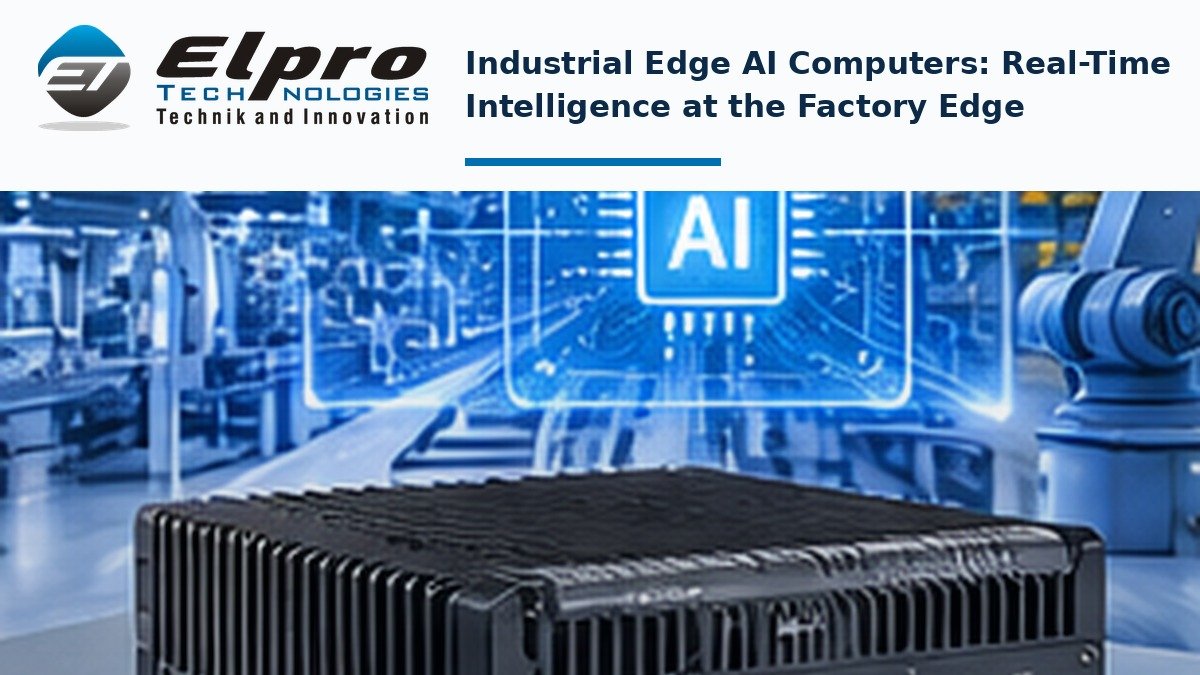
Choosing an edge AI platform is a production engineering decision: the camera, model, response target and plant environment all shape the computer specification.
A New Intelligence Layer on the Factory Floor
A production line can generate more information in a minute than a remote system can comfortably inspect in real time. Industrial edge AI computers bring processing closer to cameras, sensors and machines, helping teams interpret events where they occur. For manufacturers exploring machine vision, defect detection, equipment monitoring or local decision support, the important question is not simply how powerful a computer can be, but how well its computing platform fits the process, environment and response time.
From Raw Signals to Useful Decisions
An edge AI deployment typically combines image or sensor acquisition, local processing, application logic and communication with plant systems. A camera may capture a component, an inference model may classify its condition, and the result may be sent to a PLC, historian or quality application. The system design should define what happens when a result is uncertain, a camera disconnects or network access is interrupted. Local processing can reduce dependence on round trips to a remote server, but it still needs a clear fallback and escalation path.
Choosing Compute for the Actual AI Workload
AI workloads vary considerably. A compact gateway handling sensor anomalies has different requirements from a multi-camera inspection station running deep-learning inference. Assess model size, image resolution, frame rate, number of streams, preprocessing, latency and concurrent applications. CPU-only, GPU-accelerated and specialist AI accelerator platforms each suit different workloads. Benchmark the intended model on the proposed hardware and leave capacity for operating-system services, logging and future model revisions.
Camera, Sensor and Machine Connectivity
A reliable edge computer must connect to the equipment around it. Prepare an interface schedule covering Gigabit Ethernet, USB, serial ports, camera interfaces, digital I/O, display outputs and any required expansion. Check the number of independent network ports, throughput, cable lengths, connector retention and driver support. For machine vision, verify camera compatibility, synchronization needs and data bandwidth. Protocols and electrical characteristics should be validated against the exact PLC, sensor and peripheral models.
Thermal Design and Plant Conditions
AI inference can create sustained processor and accelerator loads, so thermal design matters as much as peak performance. Consider ambient temperature, cabinet airflow, mounting orientation, dust, vibration and available clearance. Fanless systems can reduce moving parts and dust intake, but their heat must still move through the chassis into the surrounding environment. A fan-cooled platform may be appropriate for a higher thermal envelope if filtration, maintenance and airflow are properly planned.
Data Governance, Security and Model Lifecycle
An edge AI computer is part of the plant’s operational technology environment. Plan device identity, user access, network segmentation, secure remote maintenance, software updates and recovery images. Decide whether images remain local, are stored for audit, or are transmitted to a central system. Model versions should be traceable, with documented validation data and a controlled rollback method. This helps teams understand why a model changed its decision after a software or production update.
Building a Complete Edge AI Solution
The computer is only one part of a deployable system. A practical bill of materials may include an industrial edge AI computer, GPU or accelerator module, industrial camera, lens and lighting, sensor interface, storage, network switch, mounting hardware and a protected power supply. Consider operator review screens and rugged mobile devices where inspection or maintenance teams need access to results. Elpro’s related industrial PC platforms and industrial computer solutions can be reviewed alongside edge AI options.
Pilot, Measure and Scale with Confidence
Start with one inspection point or machine cell and define measurable acceptance criteria: detection accuracy, false rejection rate, cycle time, uptime, recovery behavior and operator response. Run the system under real production lighting, vibration and network conditions, not only in a laboratory. Record model, BIOS, driver and application versions before expanding to additional lines. Related industrial edge AI computers, rugged tablets and touchscreen kiosk systems can support connected inspection and operator workflows.
Related Industrial Product Categories
- Industrial edge AI computers
- GPU-accelerated industrial PCs
- Fanless embedded computers
- Industrial cameras and vision peripherals
- Industrial Ethernet and I/O accessories
- Industrial SSD storage
- Touchscreen operator displays
- Rugged tablets for inspection and maintenance
Explore Related Elpro Technologies Solutions
Explore rugged tablet PCs for industrial field operations, touchscreen kiosk systems, industrial PC solutions, industrial computer platforms and industrial edge AI computers to understand related computing options across connected industrial environments.
Frequently Asked Questions
What is industrial edge ai computers used for?
They process data close to the machine or sensor source for tasks such as image inspection, anomaly detection, local analytics, event filtering and machine-side decision support. The precise function depends on the application model and connected equipment.
Which industries commonly use industrial edge ai computers?
Discrete manufacturing, electronics, automotive, packaging, food processing, logistics and process industries may use edge AI where local inspection or analysis is useful. The value should be demonstrated against a defined production task.
How should a buyer define the required configuration?
Document camera count, image resolution, model type, frame rate, target latency, PLC interfaces, storage, operating temperature, mounting and network architecture. This information makes hardware comparison more accurate.
How do processor and memory requirements affect selection?
Inference speed and concurrent workloads depend on the CPU, GPU or accelerator, memory bandwidth and software stack. Test the actual model and data stream rather than relying only on a processor’s headline specification.
Which interfaces should be checked before ordering?
Check Ethernet speed and count, USB, serial, camera connections, display outputs, digital I/O and expansion. Verify drivers, connector types and supported bandwidth for the exact camera and sensor models.
Can this equipment connect with PLC, SCADA or MES systems?
Yes, where the selected drivers, protocols and network architecture support the target controller or platform. Test tag exchange, timing, fault handling and restart behavior with the actual PLC or SCADA environment.
What operating-system and software checks are important?
Confirm OS version, accelerator runtime, camera SDK, AI framework, drivers, application licensing and update policy. Lock a validated software image for production and document the procedure for controlled upgrades.
How should temperature and environmental conditions be assessed?
Measure ambient and enclosure temperature under sustained inference load. Review cooling method, airflow, heatsink clearance, vibration, dust and cabinet installation; do not assume a fanless label alone proves environmental suitability.
Is the equipment suitable for continuous operation?
It can be, provided the complete configuration is rated and validated for the expected duty cycle, temperature, power quality and workload. Run a sustained pilot and define monitoring and recovery procedures.
Can the solution be integrated into an existing installation?
Often yes, but integration depends on available network ports, protocols, machine interfaces, cybersecurity rules and physical space. Map the current control architecture before adding an edge node.
What should be tested before commissioning?
Test inference accuracy, cycle time, image acquisition, network loss, PLC communication, thermal stability, power recovery, data retention and operator escalation. Record the tested hardware and software revisions.
What information should be shared when requesting a quotation?
Share the AI model and framework, camera specifications, image rate, target latency, accelerator needs, PLC interfaces, OS, storage, environment, mounting, quantity and production duty cycle.
Elpro Technologies
ELPRO TECHNOLOGIES
Technik and Innovation
#43, 2nd Cross Road, P&T Colony, R.T. Nagar, Bengaluru – 560032
sales@elprotech.in | info@elprotech.in
+91-8892147021 | +91-8892147023
www.elprotech.in