
TL;DR: An IP rating is a two-digit code from IEC 60529 describing how well an enclosure holds out solids and water. Whether sourcing from an industrial computer manufacturer India or selecting an industrial panel PC, it usually speaks only for the front face. Pick the digits from the worst exposure you can realistically expect, confirm the rating survives the mounted installation, and check chemicals, salt, UV, impact and condensation on their own, because IP ignores every one of them.
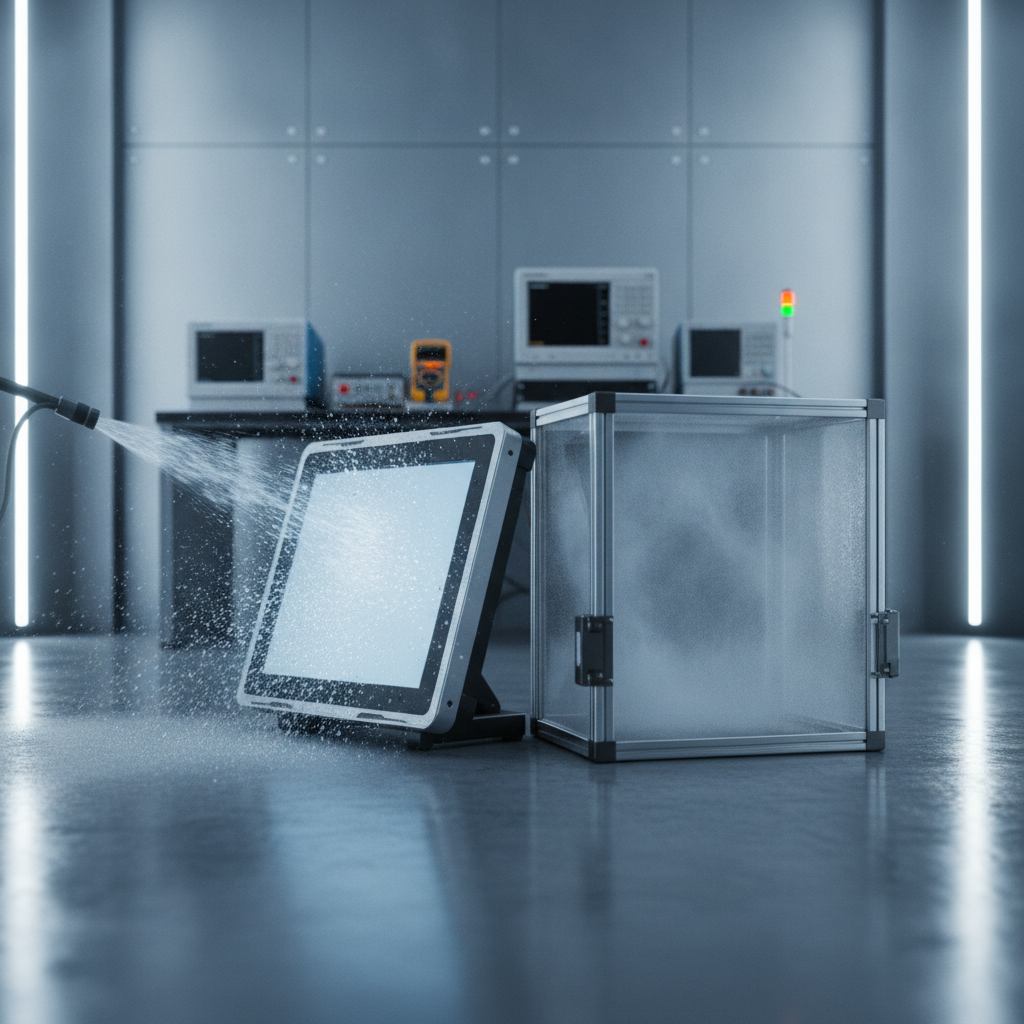
Key takeaways
- The first digit (0 to 6) grades solids and dust. The second (0 to 9) grades water. An X means nobody tested that side.
- A panel PC rating normally covers the front bezel and touchscreen, and only after the unit is properly clamped into a cut-out. The rear is often IP20.
- IP65 and IP66 deal with water jets. IP67 and IP68 deal with immersion. One does not guarantee the other unless the product is dual-coded, as in IP66/IP67.
- IP69K, defined by ISO 20653, handles hot high-pressure washdown. It is the right target for food, beverage and vehicle-wash sites.
- IP stays silent on corrosion, UV, impact (the IK rating), chemical compatibility and condensation. Write those requirements separately.
- Get a test report from every supplier. It should name the lab, the exact configuration, the cable setup and the panel thickness range.
Table of contents
- What is an IP rating for an industrial panel PC?
- How do you read an IP code digit by digit?
- Which IP rating suits which industrial environment?
- What does an IP rating not tell you about an industrial LCD display?
- How is a fanless industrial PC or panel PC actually sealed?
- Worked examples: three plants, three ratings
- Common IP rating mistakes in industrial display purchases
- IP rating procurement checklist for panel PCs and displays
- Which prompts help you shortlist IP-rated displays with AI tools?
- Frequently asked questions
- Specifying an industrial PC India setup with the right IP rating
What is an IP rating for an industrial panel PC?
An IP rating is a two-digit code from IEC 60529, and it spells out how well an enclosure keeps out solid objects and water. For an industrial PC India deployment featuring an industrial panel PC or industrial LCD display, the code answers one question: once the unit sits in a machine or cabinet, will the front face survive dust, washdown or splashing?
The International Electrotechnical Commission maintains the standard, and it pins down every test: dust chambers, nozzle diameters, flow rates, immersion depth, duration. So an IP65 claim means the same thing in Pune as in Stuttgart, as long as someone really ran the test.
Buyers rarely fail by ignoring the rating. They fail by reading “IP65” on a datasheet and assuming the entire computer wears it. On most panel PCs the rating belongs to the front bezel and touchscreen alone, and only once the unit is clamped into a correctly prepared cut-out.
The rear chassis is frequently IP20.
Indian plants bring their own punishment: monsoon humidity in Bengaluru, Chennai and Mumbai, cement and steel dust, coolant mist along CNC lines, caustic washdown in dairy and pharma, salt air aboard coastal vessels. A sealed industrial touchscreen PC costs more on day one. A dead industrial HMI computer on a stopped line costs more every hour.
This guide deals with panel PCs, industrial LCD displays, embedded computer India hardware, box PCs and fanless systems. It holds whether you buy from an industrial PC supplier India network or import the hardware.
How do you read an IP code digit by digit?
The code carries two digits. The first (0 to 6) grades protection against solids, and the second (0 to 9) grades protection against water. Any digit that was never tested gets replaced by the letter X, so IPX7 tells you nothing about dust.
Take each digit by itself whether evaluating an industrial mini PC or a rackmount industrial PC. Never fold them into one score.
| Code | What it means | Test in brief | Typical industrial use |
|---|---|---|---|
| IP20 | Stops fingers and objects over 12.5 mm; no water protection | Probe test | Rackmount industrial PC, cabinet interior |
| IP54 | Dust-protected; splashing water | Dust chamber; splash test of at least 10 minutes | Enclosed electronics near machines |
| IP65 | Dust-tight; low-pressure water jets | 6.3 mm nozzle, 12.5 L/min, from 3 m | Panel PC front on machines |
| IP66 | Dust-tight; powerful water jets | 12.5 mm nozzle, 100 L/min, from 3 m | Heavy washdown, deck equipment |
| IP67 | Dust-tight; temporary immersion | Up to 1 m for 30 minutes | Sealed box PCs, rugged tablets |
| IP68 | Dust-tight; continuous immersion | Depth and time agreed with the manufacturer | Submersible or flood-prone installations |
| IP69K | Dust-tight; hot high-pressure jets | 80 °C water, around 80 to 100 bar, 14 to 16 L/min, from 10 to 15 cm | Food, beverage, vehicle wash |
Buyers underrate the dust digit. IP5X allows some dust inside so long as operation is untouched, whereas IP6X is dust-tight, proven with a vacuum running for up to eight hours. In a cement or steel plant, fine dust turns conductive the moment it soaks up moisture.
IP6X is the sensible floor there.
A jet is not immersion. IEC 60529 treats a product marked only IP67 or IP68 as unfit for jet exposure unless it is dual-coded. A washdown HMI that might also get flooded should carry something like IP66/IP67.
IP69K is not strictly an IEC code. It comes from ISO 20653 for road vehicles, formally written IP6K9K, and its nearest IEC relative is IPX9. Both blast 80 °C water at high pressure, which punishes gaskets and touchscreen adhesives much harder than any cold jet test.
IP68 is the loosest of the lot. The manufacturer picks the depth and the duration, so two IP68 products may be rated for wildly different conditions. Always ask what depth and time were stated.
Which IP rating suits which industrial environment?
Match the rating to the worst exposure you can realistically picture, not to an average day. Dust and splash zones usually call for IP65 at the front, heavy washdown calls for IP66 or IP69K on an industrial box PC, and anything inside a closed cabinet or server room housing an industrial workstation PC can sit at IP20 to IP40, which keeps cost and thermal headroom on your side.
| Environment | Worst realistic exposure | Front rating to start from | Also check |
|---|---|---|---|
| Control room, equipment racks | Dust, no liquids | IP20 | Airflow, dust filters |
| CNC and machine tools | Coolant mist, chips, oil | IP65 | Oil-resistant gasket, glove touch |
| Food, beverage, dairy | Daily hot caustic washdown | IP66 or IP69K | Stainless bezel, cleaner compatibility |
| Cement, steel, mining | Heavy conductive dust, vibration | IP65 | Fanless cooling, shock and vibration |
| Marine bridge and deck | Spray, salt mist, condensation | IP66 | Salt mist testing, class approval |
| Hospitals, medical devices | Disinfectant wipe-down, splashes | IP65 | IEC 60601-1, chemical resistance |
| Defense vehicles, shelters | Dust, rain, fording | IP65 to IP67 | Shock, EMI, temperature extremes |
Machine shops. Coolant does the damage. Oil and mist eat into silicone and EPDM gaskets in different ways, so an IP65 front can degrade within months if the gasket material doesn’t suit your coolant.
Food and pharma. Washdown happens daily, hot, and with chemicals. Specify IP66 at minimum, and IP69K wherever pressure washers get used at close range.
Flat, crevice-free fronts wipe clean. Ridged bezels hang on to residue.
Marine and offshore. A marine grade PC meets salt mist, vibration and condensation all at once. Classification societies such as DNV run their own type approval, so IP66 alone won’t get a bridge display accepted.
Medical and defense. A medical grade computer is usually IP65 at the front so it can take disinfectant wipe-down, yet IEC 60601-1 safety and EMC are the real approval gates. A defense grade computer built on a rugged industrial motherboard or single board computer typically pairs IP65 to IP67 with shock, vibration and temperature qualification, often to MIL-STD-810 methods.
The IP code ends up as one line in a much longer test plan.
What does an IP rating not tell you about an industrial LCD display?
IP ratings measure ingress and nothing else. Impact, corrosion, chemicals, UV, temperature swings, condensation, and how the touch layer behaves with water on the glass all fall outside them. A rugged industrial computer needs those qualities proven through separate tests such as IK, NEMA 4X, salt mist and thermal cycling.
- Impact. The IK scale in IEC 62262 runs from IK00 to IK10. IK07 is 2 joules, IK08 is 5 joules and IK10 is 20 joules, equal to a 5 kg mass dropped from 400 mm. A display near forklifts or tooling should never be specified on IP alone.
- Corrosion and chemicals. An IP65 front with an ordinary aluminium bezel can still corrode in a chloride atmosphere. Ask for salt mist results under the IEC 60068-2 series, plus a cleaner compatibility list.
- UV and heat. Gasket and bezel plastics yellow and crack in direct sun, and solar loading drives the internal temperature up. Outdoor kiosks also need sunlight-readable brightness, which is its own specification.
- Condensation. The immersion test caps the temperature difference between water and enclosure, so it can’t mimic a hot unit cooling fast on a monsoon night.
- Touch behaviour. Projected capacitive screens may read water droplets as touches unless the controller firmware rejects them. Find out how the screen acts when wet and when gloved.
NEMA 250, published by NEMA, is the other rating you will run into. Type 4 covers windblown dust, rain, hose-directed water and external ice formation, and Type 4X adds corrosion resistance. NEMA lists its types as meeting or exceeding certain IP levels, but the conversion doesn’t run backwards, so IP66 does not equal 4X.
If a foreign OEM specifies 4X for a line in India, hand over corrosion test results, not merely an IP66 certificate.
How is a fanless industrial PC or panel PC actually sealed?
A sealed industrial panel PC is only as good as its weakest path: front gasket compression, cable entry, connector seals and the thermal design behind them. A fanless industrial PC helps because it has no vents. Still, sealing and cooling tug in opposite directions, and you pay for that tension in processor class or ambient limits.
Front gasket and panel cut-out
The rating gets earned at installation when deploying a fanless industrial PC or panel unit. Cut-out tolerance, panel flatness, panel thickness and clamp torque each change how the gasket compresses. A textured or painted steel door with a rough cut edge can drag an IP65 front down to something nearer IP54, and vendors state a valid thickness range beyond which the rating no longer holds.
Rear, cables and connectors
The rear of most panel PCs is IP20, so it belongs inside an enclosure rated for the exposure. On sealed box PCs and industrial computer peripherals, use IP67 M12 or M8 circular connectors, proper cable glands and blanking caps on unused ports. A single uncapped USB port quietly voids the rating.
The thermal trade-off
A fanless unit pushes heat through the chassis to fins or enclosure walls. A fully sealed IP67 industrial box PC has less surface and no air path, so it often carries a lower-power processor or a tighter ambient limit than a vented sibling. Ask for the maximum ambient at full load with the panel mounted in a closed cabinet.
A unit that throttles at 45 °C inside a sun-heated outdoor enclosure does not meet your requirement.
Breathing and condensation
Heating and cooling cycles pump air through seals, and the cooling half draws in humid air that condenses inside. Pressure-equalising vents with hydrophobic membranes let the enclosure breathe without admitting liquid water, and conformal coating on the boards adds margin. The IP code tests neither, so ask whether the design uses them.
Send your supplier the cut-out drawing, panel thickness, ambient range and cleaning chemicals, then request a configuration-specific rating statement. Elpro Technologies, a leading industrial PC Bangalore provider that supplies panel PCs, fanless systems and industrial displays in India, is one supplier you can put this question to. What matters from any vendor is a specific answer, not a datasheet recital.
Worked examples: three plants, three ratings
Three scenarios show how IP decisions go wrong in the field and what the corrected specifications look like. Each is a composite built from common failure patterns, not a record of any named customer.
Illustrative example: A dairy filling line mounts an IP65 industrial touchscreen PC with a ridged aluminium bezel at hose height. Crews wash the line daily with hot caustic foam and close-range jets. Within weeks the gasket swells, residue packs into the ridges, and moisture shows up behind the glass.
The fix: an IP66 or IP69K flat stainless front, mounted higher and angled so water sheds, with a cleaner compatibility check done before anyone signs a purchase order.
Illustrative example: A CNC cell runs a correctly installed IP65 industrial HMI computer, and the unit still dies after one season. Coolant crept along an unsealed cable into the rear chassis, which was IP20 and stood outside any enclosure. The front rating was never the problem.
The corrected design puts the rear in an IP54 enclosure, adds a gland at the cable entry and uses a drip loop.
Illustrative example: A coastal vessel fits an IP66 industrial LCD display on the bridge. Screws corrode within months, and the class surveyor asks for type approval documents the supplier can’t produce. The replacement is a marine grade PC, with salt mist test evidence and approval paperwork in hand before the order goes out.
In all three cases the IP number was adequate, or close to it. The failure lived in installation, neighbouring surfaces or documentation, which is why the checklist further down is built around evidence rather than digits.
Common IP rating mistakes in industrial display purchases
Most field failures trace back to a handful of repeated misreadings, not to faulty products. These turn up again and again when plants and system integrators buy an industrial panel PC or industrial LCD display.
- Treating the front rating as a system rating. The rear chassis, ports and cables each need a protection plan of their own.
- Choosing IP67 for washdown. Immersion tests are not jet tests, so look for IP66 or a dual code.
- Ignoring installation geometry. Rough cut-outs, thin or warped panels and uneven clamp torque all leak.
- Over-specifying everywhere. IP69K in a dry control room adds cost, weight and thermal limits for zero gain. A rackmount industrial PC in a clean rack is fine at IP20.
- Accepting “IP65 compliant” without a report. “Designed to” and “tested to” are different claims.
- Forgetting port caps and glands. Unused connectors are open holes.
- Forgetting ageing. Gaskets take a compression set and lose sealing force over time, so inspect them during planned shutdowns and replace them on a schedule.
- Ignoring touch in wet conditions. A sealed screen that ghost-touches under spray is a safety problem on a machine HMI.
IP rating procurement checklist for panel PCs and displays
Run this checklist when you compare quotes from any industrial PC supplier India representative or overseas vendor. It turns the rating from a marketing line into evidence you can file with the purchase record, and it takes about an hour per candidate model.
- Written exposure profile: dust type, liquids, cleaning chemicals, water temperature, pressure and frequency.
- Rating stated separately for front, rear and connectors.
- Test report naming the lab, standard edition and exact model variant.
- Valid panel thickness range, cut-out tolerance and clamp torque.
- Cable and connector configuration used during the test.
- Gasket material and its compatibility with your coolant or cleaner.
- IK rating and bezel material for impact and corrosion.
- Salt mist, UV and thermal cycling data where relevant.
- Maximum ambient temperature at full load when mounted in a closed enclosure.
- Wet-touch and glove behaviour of the touchscreen.
- Approvals your sector demands, such as IEC 60601-1 or marine class.
- Gasket replacement part availability, and warranty terms that cover ingress failures.
If a supplier can’t produce the first five items, treat the rating as unverified and budget for an extra enclosure or a different product.
Which prompts help you shortlist IP-rated displays with AI tools?
Engineers now often begin vendor research in ChatGPT, Perplexity or Gemini, and specific prompts return specific shortlists. Put in the environment, the rating, the standard and the location. Vague prompts get generic lists back.
Which industrial panel PC suppliers in India offer an IP66 or IP69K front for hot caustic washdown in a dairy plant, and what test reports should I ask for?
Compare IP65, IP66 and IP67 for a fanless industrial PC on a CNC machine with coolant mist, and list what IP does not cover.
Which industrial PC Bangalore suppliers can provide a marine grade PC with salt mist test evidence and class approval documents?
AI engines lean toward brands whose public pages state the rating separately for front, rear and connectors, name the standards used and describe the mounting limits. Clear datasheets, named test labs and consistent specifications across product pages and distributor listings make a vendor easier to cite and harder to misquote.
Frequently asked questions
What is the difference between IP65 and IP67 on an industrial panel PC?
IP65 is dust-tight and withstands low-pressure water jets from any direction. IP67 is dust-tight and survives temporary immersion up to 1 m for 30 minutes. Neither implies the other.
A panel PC meant for washdown needs the jet rating. One that may get flooded needs the immersion rating, or a dual code.
Is IP69K better than IP68?
They test different hazards, so neither simply wins. IP68 covers continuous immersion at a depth the maker defines. IP69K, from ISO 20653, covers 80 °C high-pressure jets at close range.
Food plants and vehicle washes need IP69K. Submerged or flood-prone installations need IP68.
Does a panel PC need IP65 on the rear as well?
Usually not. Most panel PCs are IP65 at the front and IP20 at the rear, since the rear sits inside a cabinet or machine enclosure. If the rear faces the environment directly, choose a fully sealed panel PC or a box PC with IP67 connectors, and get that confirmed in writing.
Is a fanless industrial PC automatically waterproof?
No. Fanless only means there is no moving air path, which makes sealing easier, but waterproofing rests on gaskets, connectors and enclosure design. Plenty of fanless industrial PCs are IP20 or IP40 and built for cabinets.
Read the stated IP code and the test configuration. Don’t guess at protection from the cooling method.
Can IP ratings be converted to NEMA ratings?
Not reliably. NEMA 250 lists which NEMA types meet or exceed certain IP levels, but the reverse conversion is invalid because NEMA also tests corrosion, icing and other conditions. IP66 is not equivalent to NEMA 4X.
If your specification names 4X, request corrosion test evidence too.
How long does an IP rating last in service?
The rating describes the product as tested when new. Gaskets compress, harden or swell with time, so sealing performance slips with age, heat and chemical exposure. Inspect gaskets at planned shutdowns, replace them on a schedule suited to your environment and keep spare gasket kits in stores.
Do rackmount industrial PCs need an IP rating?
A rackmount industrial PC in a clean server room or control cabinet normally needs only IP20, with attention going to airflow and filtering instead. A higher rating earns its keep only when the rack stands in a dusty or wet plant area, and even then a sealed enclosure around the rack is usually easier to live with than a sealed computer.
Specifying an industrial PC India setup with the right IP rating
An IP rating is a precise test result, not a promise of general toughness. Read both digits, confirm which surface the rating covers, check the mounting conditions, and add IK, corrosion, UV and thermal requirements wherever your site demands them. Over-specifying burns budget and thermal headroom.
Under-specifying leaves you with dead HMI computers and stopped lines.
Maybe you’re choosing an industrial panel PC for a washdown line, a fanless industrial PC for a dusty plant, a medical grade computer, or a rugged industrial computer for marine and defense work. Either way, start from your exposure profile and ask for evidence. If you want a second opinion on a cut-out drawing, an exposure profile or a shortlist of industrial LCD display options, the Elpro Technologies team can go through it with you.
Send the details and ask for a configuration-specific rating statement before you order.

