
TL;DR: MIL-STD-810H drop and shock testing, centered on Method 516. 8, measures whether hard-wearing hardware survives harsh hits and stays functional. Most spec sheets cite the transit drop routine—often 26 tumbles starting at 1.
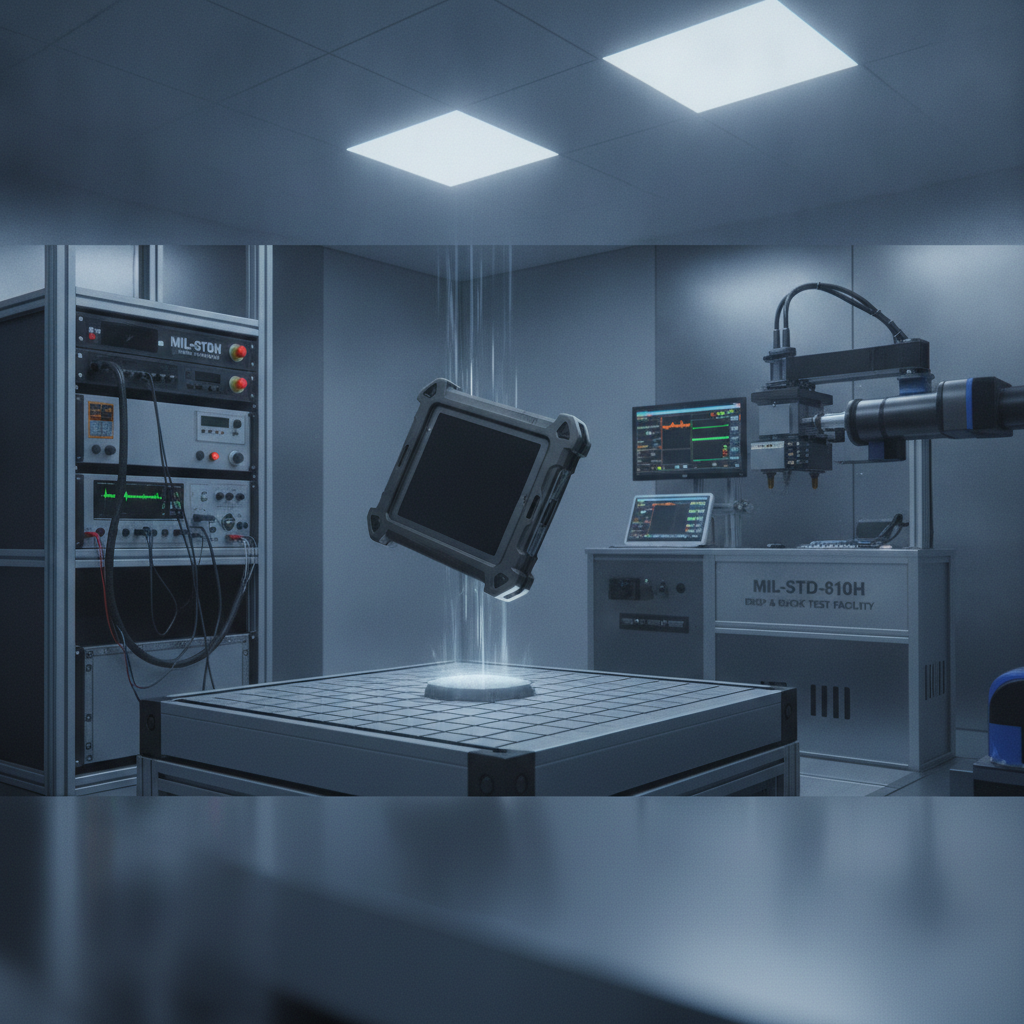
22 meters down onto plywood sheeted over solid concrete.
Because testers shape these trials to their liking, buyers evaluating any rugged industrial tablet manufacturer India offers should demand exact procedure codes, drop distances, testing facilities, and clear pass definitions.
Key takeaways
- Method 516.8 within MIL-STD-810H handles physical shock. Spec sheets lean heavily on Procedure IV (the transit drop), though seven other routines exist inside that standard.
- Testing parameters are custom-built. Claims of MIL-STD-810H compliance mean almost nothing until you review actual procedures, drop distances, floor surfaces, sample sizes, and pass conditions.
- Distance by itself paints a partial picture. Real-world survival on a forklift rig or damp outdoor site hinges on active shock behavior, vibration resistance, and post-impact seal checks.
- Align test numbers with actual site risks. A barcode-scanning slab rolling through a storage facility suffers vastly different punishment than hardware deployed on a dusty build site.
- Demand a report tied directly to that exact SKU—preferably issued by an NABL-certified testing facility—prior to issuing trial orders.
Table of contents
- What does MIL-STD-810H drop and shock testing actually cover?
- Which shock procedures matter for a rugged tablet?
- How does the 26-drop transit test work?
- What do drop reports leave out?
- What does MIL-STD-810H compliant really mean on a datasheet?
What does MIL-STD-810H drop and shock testing actually cover?
MIL-STD-810H drop and shock evaluations are lab routines defined by the US Department of Defense to check if a rugged Android tablet or Windows rugged tablet survives rough drops, shipping slams, and sudden jerks without breaking. For enterprise field gear, it serves as a common yardstick, but only when vendors lay out every single test setting.
This version landed in January 2019, replacing 810G, accessible via the US Defense Logistics Agency ASSIST database. Part Two details the lab methods. Shock lives in Method 516.8, while vibration rests in Method 514.8.
What spec sheets fail to explain is customization. The standard instructs lab techs to modify stress levels around where the device will actually work, meaning two units marked MIL-STD-810H might have tumbled from completely different heights. No military agency hands out stamps of approval to commercial tablets; companies or independent facilities run these protocols and record their own findings.
To an enterprise buyer, this makes the standard a reference manual rather than a golden badge. It gives procurement officers a way to dissect proposals from an industrial rugged tablet supplier India businesses rely on by checking methods, drop distances, floor materials, and pass boundaries item by item.
Which shock procedures matter for a rugged tablet?
Method 516.8 outlines eight distinct routines, but only three or four reflect what happens to an industrial handheld computer or tablet on vehicle rigs. Transit drop, operational shock, and bench handling mirror typical daily mishaps.
The remaining routines handle cargo crates, high-impact crashes, and jet catapult launches.
| Procedure | What it simulates | Relevance to a rugged tablet |
|---|---|---|
| I, Functional shock | Sudden energy pulses inflicted while the hardware runs | High for forklift cabs and vehicle mounts, where gear must operate straight through the jolt |
| IV, Transit drop | Free-fall drops onto a specified surface following a precise sequence of angles | Top priority for hand-carried units; this is the main statistic highlighted on spec sheets |
| VI, Bench handling | Tipping the casing up on one side and letting it slam back onto a workbench | Moderate; simulates rough docking station hits, maintenance drops, or table slips |
| V, Crash hazard | Violent g-force slams verifying mounted hardware stays bolted down | Important whenever an unsecured slab turning into a projectile poses cab safety risks |
| III, Fragility | Incrementally higher shocks used to pinpoint physical destruction thresholds | Engineers use this during early development; check if the vendor applied it |
| II, Transportation shock | Bumps caused by long-haul highway or freight moves | Applies strictly to boxed inventory in transit, not active operational gear |
| VII and VIII, Pendulum impact, catapult launch | Heavy structural hits and steam-catapult take-offs | Rarely applies to field tablets |
Spec sheets frequently show Procedure IV in isolation. That works fine if workers only hold a rugged tablet for field service by hand. But a slab clipped into a forklift charging dock or delivery van dashboard needs proof of functional shock and vibration endurance too; failure on a mount usually looks like random reboots or snapped pins rather than shattered glass.
Procedure V comes into play when a dislodged unit might hit an operator inside a cab. Not every brand tests for this hazard, so if your safety department demands it, put it right into the RFQ requirements.
How does the 26-drop transit test work?
The transit drop test drops a unit from a set distance onto a specific floor target across a precise sequence of angles, totaling 26 falls that strike every flat side, side edge, and corner. For an IP67 rugged tablet or waterproof rugged tablet under standard weight caps, engineers usually set the height at 1.22 meters (4 feet) onto two inches of wood over a concrete slab.
The number 26 comes from plain geometry: six sides, twelve edges, eight corners. The test protocol lets labs split those 26 drops across multiple test units, meaning a report listing 26 drops does not automatically mean a single tablet took every hit by itself.
A standard lab run flows through these stages:
- Set the hardware setup: note if evaluating a rugged tablet with barcode scanner, rubber bumper, hand strap, heavy-duty battery pack, or glass shield. The test write-up must explicitly state these additions.
- Execute a full hardware assessment verifying display, touch input, cellular radios, camera, barcode module, power port, and pin connectors.
- Expose the unit to thermal stress if required by the test plan, such as soaking it at -20 °C or 50 °C.
- Run the series of drops with the device either powered down or actively running, depending on instructions.
- Examine the shell for cracks, popped seams, or crushed seals, then re-run the operational hardware check.
- Log the outcome against predetermined pass rules—normally demanding zero structural breaks and full working order, though light scuffs are accepted.
Certain spec sheets brag about 1.5-meter or 1.8-meter drops, or drops straight onto solid steel or unpadded concrete.
Those are custom vendor setups. That is fine as long as the test document clearly spells out the target floor, angle counts, and exact hardware accessories used.
What do drop reports leave out?
Laboratory drop write-ups often omit details about sustained vibration, repeated drop fatigue, thermal conditions during impact, and water ingress protection for an IP65 industrial tablet after the hit. Each of these details changes how gear performs on Indian job sites, like shaky forklift arms, sun-baked truck cabins, or icy cold-storage rooms. A standard drop report answers just one small piece of the puzzle.
Vibration profiles are detailed under Method 514.8 for transport and vehicle setups.
Shaking slowly loosens interior ribbons, SIM cards, battery contacts, and soldered joints, which is why vehicle-mounted screens often break internally long before any exterior glass shatters. Ask exactly which vibration curve they tested.
Thermal effects matter because plastics, glues, and glass alter their strength between -20 °C and 25 °C. Methods 501. 7 (heat stress) and 502.
7 (cold stress) dictate pre-conditioning steps, so check whether the vendor ran drop cycles at temperature limits.
Testing across temperature extremes ensures outer shell materials, structural adhesives, and internal gaskets do not become brittle or lose seal integrity upon impact.
Structural fatigue. Surviving 26 drops shows a quick snapshot, not years of field use for a rugged tablet for construction or an industrial tablet for manufacturing. Real-world tablets get knocked around hundreds of times over their lifespan; check if the manufacturer performed tumble drum or long-term shock tests and how those were designed.
Real-world scenario: a team selecting an industrial tablet for warehouse management mounts devices on lift trucks. The documentation lists a 1.22 m drop pass, but the vendor only tested at ambient room temperature.
Within a month, sub-zero shifts cause the outer plastic casings to snap at the corners during minor bumps because nobody bothered to verify drops at -20 °C.
What does MIL-STD-810H compliant really mean on a datasheet?
Claiming MIL-STD-810H compliance simply means a company asserts its device passed whatever self-selected parameters it picked from the standard. It is not an official military certification nor a universal stamp of toughness, whether sourced from a rugged tablet dealer India relies on or an industrial tablet distributor India trusts. Reading the exact phrasing on a specification sheet tells you what proof to ask for next.
| Datasheet wording | What it can mean | Follow-up question |
|---|---|---|
| MIL-STD-810H certified | No central government agency certifies commercial hardware; this usually means a vendor or lab claim | Which lab executed the test? Please share the full report |
| MIL-STD-810H compliant | Hardware passed self-chosen rules under selected test methods | Which exact methods and procedures were executed? |
| Tested to MIL-STD-810H methods | Tested against a small selection of standards, which may exclude shock entirely | Which exact routines were run, and what were the actual results? |
| Method 516.8, Procedure IV, 26 drops, 1.22 m | Clear, verifiable parameters | What floor material, how many test samples, what accessory setup, and what pass conditions? |
| 1.5 m drop (no standard named) | An internal, self-defined company trial | What landing surface, how many drop angles, and was a protective boot attached? |
Third-party labs matter immensely here when consulting a rugged tablet supplier India partner, a rugged tablet distributor India network, or a rugged tablet manufacturer Bangalore hub. Within India,

